Showing posts with label Research. Show all posts

Tuesday, July 10, 2012

More travel photos...

I'm glad to be home, sleeping in my own bed. But being on the road and doing research was a real treat. I have learned (the hard way) that rummaging archives takes longer than I'd imagined. I thought two weeks in one archive with one collection was way more than enough time... nope. I'll need to make another trip to finish up. I also learned (the hard way) that I will burn out staring at documents all day, and I need to take waaaay more breaks than I was.  This is all stuff I was told and thought I'd taken into consideration. Just not enough consideration, as it happens....

More photos from the road:

Offering to the archaeologist? Ceramics found on a tree stump.
Warren County, New York, June 28, 2012


Spring head. Water oozes out of the ground here,
forming a stream just beyond the bend. Warren County
New York, June 28, 2012.


Family walk. Eastern Townships, Quebec, July 1, 2012

Toasting marshmallows. Eastern Townships, Quebec, July 1, 2012

Moonrise. Eastern Townships, Quebec. July 1, 2012


Tuesday, June 26, 2012

Off the Interstate

Driving the old highways off the Interstates takes longer... but can be infinitely more rewarding.

Robot moose. Route 9, near Queensbury, New York. June 26, 2012.
 
World's Tallest Uncle Sam (and Shorty Santa),
Magic Forest (Diving Horse! 25 Rides! 2 Shows!),
Lake George, New York. June 26, 2012.

World's Tallest Uncle Sam sign, Magic Forest, Lake George, New York, June 26, 2012.


Saturday, June 2, 2012

Etymology of Snail Mail: Like, way older than 1983...

The Online Etymology Dictionary gives 1983 as the first use of "snail mail" to reference letters written on paper delivered by the post office vs. electronic communication.

They missed the mark by almost 140 years...

The Philadelphia North American [of January 15, 1846] welcomed the telegraph with the pronouncement: "The markets will no longer be dependent upon snail paced mails." (Howe 2007: 695)

Gnarly.


Reference:
Howe, Daniel Walker (2007) What Hath God Wrought: The Transformation of America, 1815-1848. Oxford University Press.


Thursday, May 17, 2012

Baby Leasing

I stumbled across this doing research for something else. While I should not be writing blog posts but hauling ass on this last big paper due for this semester's coursework, I couldn't not share this. History is so far from boring that it makes my head want to explode:

The Letter. (Link to Source, Cornell University)

A 1929 letter, from the Superintendent of the Troy Orphan Asylum* (Troy, New York) to the Director of Cornell University (yep, that one) agreeing to lease infants to Cornell's home economics "practice houses." And asking please for 24 hours notice before Cornell comes to pick them up. Holy shit, people... when I was in school, it was dolls, or eggs, or, you know, seedlings. Real babies? Hard core. And very, very disturbing. There's something rotten at the core of domesticity...

* The masthead on the letter for the Troy Asylum reads both: "For children under sixteen years of age, except juvenile delinquents, truants, and mental defectives, as required by law" and "The race marches forward on the feet of little children." I'm not even going to touch these, except to copy them down.

Friday, September 30, 2011

Hallelujah

Suddenly, and really without warning, the pieces of my Why Wheels At All arguement have clicked into place. I still need to work out how to fit in the "What Other People Say About Why Wheels," but that's just literature review. And I don't think they're wrong, but are just looking at small pieces of this bigger thing, often describing the What of Wheels, and not the Why of Wheels.* The pieces just clickity-clicked together... and they're SO not the pieces I thought they were going to be.

Side moral: I'm learning that I really think best in and while writing. Apparently lots of things sound logical in my head, but fall to incoherent custard on paper.**

* Saying things are pretty because lots of similar things were pretty does not explain why it was important that those particular things were pretty.
** Nicked the phrase "falls to custard" from another participant in the Another Damned Notorious Writing Group. I like it; not as earth-shattering as going to hell, not as dire-sounding as going pear-shaped. I mean, custard's still yummy, even when it's not pretty anymore. It's just kind of sad.

Wednesday, July 13, 2011

Addicted

I've been looking for a particular bit of information for a while now. One of those "legend has it"s that I've been looking for proof of; one of those ones that you don't actively chase down, but keep an eye peeled for.

And last night? While watching Master Chef on demand (shhh, I have a secret cooking competition show vice) and screwing around on the Internets... I found it. Three lines in an obscure topical newspaper from the turn of the last century. One of those ones that makes you wonder how anyone found it to digitize in the first place, and still, what a crap shoot finding *anything* in the endless forest of digital databases is (I just happened to randomly be rooting around in what turned out to be the right place).

What a freaking rush! I felt like I'd won the lottery. I am totally addicted to this research thing...

Wednesday, June 8, 2011

We're Modern Now, Put On Pants

The Fabulous Historiann had a recent post on The Intellectual Value of Being Wrong, where she argues that conferences should be places of playing with ideas and trying out new things. I agree entirely, though I've not yet had the gumption to do it. I have, however, committed myself to a conference at the dawn of 2012 where I just might, by necessity, if nothing else (I won't have actually done any sub-surface fieldwork by the time I present...).

The post is worth a read, as is, as ever at Historiann's, the comments section. Good, insightful, and crazy-knowledgeable. And funny. I had to share this one from Rustonite; in addition to making me laugh out loud (for realz), Rustonite makes a really good point about periods and timeframes that I think we'd all do well to remember:
I don’t get why there’d be controversy about applying the word lesbian back, any more than there is about periodisations like modern and medieval. Nobody in the middle ages though they were living in the middle (of what?), and it’s not as though somebody came out at new years 1600, ringing a bell and yelling “we’re modern now, put on pants!” Everything we say is a bit anachronistic. It’s important to be aware you’re doing it, but if we tried to write non-anachronistic history we’d find it impossible.
You'll just have to visit Historiann to find out what that lesbian comment is all about!

PS: I highly, highly recommend Judith Bennett's book History Matters: Patriarchy and the Challenge of Feminism. I can't recommend it enough; it should be required reading for historians and historical archaeologists.

Saturday, April 9, 2011

Giving Good Poster

Let me preface this with the fact that I've never presented a poster at a conference. Lots of papers, but no poster. I should probably do something about that... but I find it much easier to write a talk than to prepare a poster. That said, I did prepare an information poster for work that I *really* liked and got good feedback for, so perhaps all is not lost. I -did- spend several years working in graphics-y type jobs, including book layout, copy design, and at newspapers, and I think picked up a few things along the way.

And you know, it's not a bad thing to have to force myself to think about data differently -- i.e. how to present it largely visually as a poster vs. as a narrative. Hmm.

But posters aren't just posters anymore; they're going multimedia!

Bone Girl recently posted about putting QR codes on conference posters. As a poster-maker, you go to a website (here's an example) and tell it what information you want encoded, and it feeds you a QR code that you then put somewhere on your poster. Poster-goers then snap a picture of the code (it looks like a bunch of pixels) with their smart phones and have access to whatever data is linked. It can be a digital version of the poster, poster author contact information, more detailed background, reference list... you name it. It's a great idea, especially for poster-goers who don't have time to read your poster right there and then, or who come by when you're not there, or who are notorious at losing business cards, or for things no-one has thought about yet.

QR codes are cool, and can be put to good use. But please don't forget not everyone has a smart phone, no matter how adamantly the phone companies want you to believe it's true!

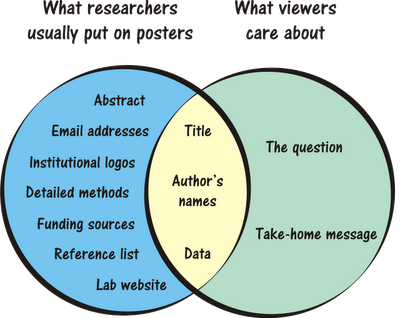
I particularly liked the link Bone Girl posted to Better Posters, a whole blog targeted to the academic crowd (by an academic). The blog contains very good general points (no more than 2 fonts, don't use comic-sans, etc.) and lots of nitty gritty (columns, color theory, poster critiques, fonts and more fonts, poster software reviews, etc.). I particularly liked this graphic, from the Poster Venn post:

I disagree that no-one cares about references, though; or contact info. But the rest? Yeah, I see his point (though some funders require you to mention them whenever you present info they paid for).

Another website on creating good posters that leads by example: An Effective Poster
This site is much more of a how-to, from start to finish, than Better Posters. If you need to make a poster fast, I recommend Effective Poster because it will sequentially walk you through the steps. If you have some additional time, or want to improve a poster you've done, or are just interested in the process and considerations, then definitely pop over to Better Posters.

Sunday, April 3, 2011

Recent Acquisitions

I've been on a bit of a book-buying spree, even though I've been trying not to. I've been making healthy use of Inter-Library Loan to get access to anthologies that have only one or two chapters I'm interested in. But sometimes... well, sometimes you get a book via ILL, and within 5 minutes of cracking it, you know you have to have it.

Since January, here are a few of the books I've acquired:

  1. Meacham, Sarah Hand (2009) Every Home A Distillery: Alcohol, Gender, and Technology in the Colonial Chesapeake. Johns Hopkins University Press, Baltimore. I'm very much looking forward to reading this as it addresses several of my research interests. Sarah did a little shameless self-promotion on the H-OIEAHC email list for early American history (where shameless = mentioned she'd written this book). I'm very glad she did!
  2. Kupperman, Karen Ordahl (1995) America in European Consciousness 1493-1750. University of North Carolina Press, Chapel Hill. Placing us as The Other; an exercise in perspective.
  3. Stilgoe, John R. (1982) Common Landscape of America, 1580-1845. Yale University Press, New Haven, Connecticut. A way to think about and see the landscape. Prompted by an increasing interest in landscape archaeology and a conference presentation by a colleague that included an anecdote of passers-by insisting that the wooded area they were digging in was "virgin forest." (Hint: not too long ago, it had been an agricultural field).
  4. Archer, Steven N. and Kevin M. Bartoy (2006) Between Dirt and Discussion: Methods, Methodology, and Interpretation in Historical Archaeology. Springer, New York. Looked at it for a chapter or two and ended up getting the whole thing. Some very interesting discussion on methodologies, including regarding the use of GIS, soil chemistry analysis, and identifying earthfast buildings. There's a great chapter on the Harris Matrix by Harris himself, about how we've not quite got it right.
  5. Hicks, Dan and Mary C. Beaudry (2006) The Cambridge Companion to Historical Archaeology. Cambridge University Press, Cambridge. I'm not generally a fan of buying field-survey anthologies, though I do recognize that they often contain great material. I usually borrow them, read them, and give them back. Yeah, I tried that with this one. I gave it back only after ordering my own copy.
  6. Groover, Mark D. (2008) The Archaeology of North American Farmsteads. University Press of Florida, Gainesville. There's a movement afoot to recognize that Not All Farmsteads Are The Same. Groover grabs the bull by the horns, and shows us -- from the colonial era through the twentieth century. And THEN he outlines a research framework for investigating farmsteads that includes scales of analysis and what sorts of questions can be answered. When two farmsteads -- even ones that date from the same time period and might even be located right next to each other -- can provide different data about the lives of the people who lived there, then both should be investigated (often, one or both will get written off and not subjected to further work, in a "you've seen one nineteenth century farm, you've seen them all" approach). Other people who have had really cogent stuff to say about this are Mary Beaudry and LouAnn Wurst.
  7. Shackel, Paul A. (2009) The Archaeology of American Labor and Working-Class Life. University Press of Florida, Gainesville. I actually can't wait to read this.
  8. Smith, Frederick H. (2008). The Archaeology of Alcohol and Drinking. University Press of Florida, Gainesville. Yes, it's a theme. Shush. It's *research*.

Sunday, December 12, 2010

Acasocial Networking Update

Back in August of 2009, I posted the results of a little experiment I conducted. Specifically, I posted some papers to several Acasocial portals to see what happened. I was particularly interested in Time-to-Google-Scholar, in an attempt to make my stuff more available for others to cite. Part of academia is, after all, getting cited. Nothing wrong with a little self-promotion; while making my work more easily accessible won't guarantee citations, if no one can find it it sure as hell won't get cited!

You can read my previous post for The Way Things Were; after assessing the features of each, I determined that "The real winner here is SelectedWorks. I can see people are accessing and downloading my stuff. It is totally easy to update my site. And, time to Google Scholar for everything (book, journal articles, conference papers) = 1 month."

In the year and a bit since I posted my results, a lot has happened. Here's an update:

Mendeley.com I am still using Mendeley as a reference management tool. In fact, I abandoned EndNote in favor of Mendeley for this purpose. Mendeley lets me access and manage my bibliography from any computer with internet access and to grab .pdfs from my personal library. From any computer with the Mendeley desktop installed, I can access, upload, read, and make comments in .pdf files. I've put Mendeley Desktop on my home computer, my laptop, and my computer at work. The ready access to my research library has been invaluable. Mendeley's incorporation of DOI has made adding journal articles to my database fast and painless.

But there is more to Mendeley. One advantage to the bibliography software is that you can group papers by whatever topics you like. Mendeley gives you the opportunity to make those groups public so you can easily share your bibliography with others, and (depending on how public you make it) can collaborate with others. I made several of my groups public, and have had several people join them. I haven't yet taken advantage of the collaboration/discussion abilities. A new improvement that I quite like is the ability to find publications related to ones I have in my bibliography; to do so, I just click the button from within the Desktop and a window opens in my browser showing how many others have that article in their databases, and a list of similar publications. I can add these other publications to my database with a quick click.

Mendeley has a free option (1GB storage space); they also have very reasonably-priced paid options (up to 15GB storage space). Their support folks are very, very responsive and helpful.


CiteULike: Although I reviewed this back in August 2009, I quit using it. Too clunky, and I much preferred Mendeley. I have no update for you.


Academia.edu: Still Facebook for academics. People are finding me and my publications via Academia (and I can see how often and when my stuff is accessed), but this isn't the real strength of the site. For me, there are three main strengths at Academia: 1) being able to follow specific journals; 2) being able to follow specific topics; 3) an environment conducive to contacting researchers.

1. Being able to follow specific journals. This is a relatively new feature, but may actually be the best part. I have pretty wide-ranging interests (I am, after all, a fox), but can't afford the money or time to follow printed journals. With Academia.edu, I can "Follow" particular journals; when they come out with new issues (or pre-publish stuff to the 'net), I see the table of contents in my feed. If a particular article interests me, I click on the feed, grab the citation, and pop over to my Friendly Neighborhood Inter-Library Loan Request Form (a total, total perk to my adjunctivity) and within a couple of days, have a .pdf version in my email. I can also see which journals others are following; I've found several of interest this way. I've found some really great stuff this way, in journals that I'd normally never read.

2. Being able to follow specific topics. Following particular researchers is great (though there are several people whose work I'd love to follow who haven't signed up to Academia yet); being able to follow particular areas of research is super-great. I've found publications and researchers using this feature that I'd not previously been aware of.

3. An environment conducive to communication. It is very easy to send a short note to others via Academia. I've had some very good exchanges with others, generally prompted by reading a paper they'd (or I'd) just posted. The setup, whereby you can read someone's paper and send them a note from the same page, that makes this sort of communication easy. Though people without an account on Academia can see my basic profile, they cannot see my updates nor send me notes without signing up. So far, I've not been on the receiving end of any weird/abusive notes.

One more note about Academia: their technical support is super-easy to access (there's a field at the bottom left of every page) and super-responsive.


SelectedWorks: No real changes here since last August. But still my favorite place to get my stuff "out there" -- fast to Google Scholar, monthly updates with statistics of downloads, and emailed notifications for whatever search criteria you give them. Not as "networky" as Academia, but I've still found papers this way (especially conference proceedings and gray literature) that haven't surfaced elsewhere. As best I can tell, more people are finding my work via SelectedWorks than all the others combined.


To my surprise, I ran experiments on four sites and ended up using three of them on a regular basis. I was expecting to find one place to dump my stuff to make it easily accessible online. What I ended up with was a suite of Acasocial Networking tools that have made my research and organization more efficient; exposed me to new research; allowed me to easily collaborate; and make my stuff more easily accessible.

Monday, October 18, 2010

And SHIFT...

That rare, amazing moment when you realize that what you're reading has fundamentally changed how you think about things? Happened to me tonight. It started as casually flipping through an Inter-Library Loan while my class wrote their mid-terms, and ended with me sitting in the classroom after everyone had left to finish the section I was reading, and wishing it wasn't borrowed, because I was itching to annotate. Obviously, not the only person to have that impulse, as there was already marginalia.

The book: Jones, Andrew (2007) Memory and Material Culture. Cambridge University Press, Cambridge.

The passage:
We take for granted the survival into the present of artefacts from past. Indeed, the discipline of archaeology would be impossible without the survival of such artefacts. What is the implication of the durability or ephemerality of past material culture for the reproduction of societies in the past? ... [R]emembrance is a process made apparent to the experiencing subject by the continual and dynamic encounter between the subject and the material world he or she inhabits rather than an abstract and dispassionate transaction between the external world and the mind. This opens up the possibility of thinking about memory differently. Rather than treating memory as a function of the internal processes of the human mind, we might consider memory to be produced through the encounter between people and the material world.
All kinds of good stuff about the dynamic production of memory and meaning between people and things (things take an active role in his approach). I haven't finished reading the book yet (barely started), but I have fireworks going off in my head.

This has happened to me twice more over the last couple of years. Once reading Judith Bennett's History Matters: Patriarchy and the Challenge of Feminism and once reading Mary Daly's Gyn/Ecology: The Metaethics of Radical Feminism. I'd bought a copy of Daly's book, but had borrowed a copy of Bennett's. I hadn't cracked it for more than 5 minutes when I ordered my own copy, lest I vandalize a library copy. My copy is now massively annotated and dog-eared. Interestingly enough, these events have not been isolated incidents, but are linked by a series of people, places, and events. I've been reading crazy-wildly lately on all sorts of topics* but these are the works that set something off.

* All sorts of topics include: the history of death; ritual concealments; fine metal refining; soils for growing tobacco; the prevalence of pig in certain foodways assemblages; colonial distilling; memory; landscapes; the Progressive era; contact period tribal organization in parts of the Mid-Atlantic; public archaeology; critical archaeology; etc. Dude, no wonder I'm tired...

Saturday, September 4, 2010

Social Annihilation

America was a very interesting place in the very late eighteenth/early nineteenth century; interesting, at least, from the distance of two hundred years.

Fresh out of the Revolutionary War, riding early waves of the Industrial Revolution and snowballing scientific discovery, Americans sorted out what it meant to be American. We left our small towns, and pushed west; we mined coal and built canals to carry it to increasingly industrialized cities, our manufacturing no longer dependent on water power. We built railroads, and new towns sprung up along them like a string of pearls. Free of the Church of England, we sought our own meaning in utopian communities and home-grown religious traditions.

It all sounds very progressive and romantic. But there was, of course, a price. When a person's world was limited to a couple of days ride by horse or buggy on shitty roads, and they knew or were related to pretty much everyone they encountered, they (and everyone else) knew exactly what their place in the community was. As people began to travel further, move to industrial centers, or set out to make their fortunes, communities became very fluid. Members of families who had lived in one place for generations would move away; people who had no family ties to an area would move in, or just stay a spell before moving on. The social order was in flux, and there were so many strangers...

It became necessary to wear your social rank and status on your sleeve; to visually advertise to the strangers around you, where you placed in the social pecking order. There was an entire ballet of right clothing, right mannerisms, right pursuits, right language that, it was assumed, only true members of the elite could pull off. But because none of these things are inherent within a person, social rank and status became contested -- people of lower social rank and status emulated the social ballet of the elite, and when too many of them got close to being good at it, the bar was moved. This even played out in cemeteries:

... the working poor tried to assure themselves a place in funerary society by securing burials in cemeteries or churchyards that were equivalent to those of the bourgeoisie, or within bourgeois cemeteries in inferior graves and spaces. The alternatives - to be sold and/or stolen, dissected, and/or displayed in a museum, or to be dumped anonymously in a mass grave in a potter's field - represented social annihilation. The dissected body was nothing but a collection of body parts and waste, a thing; potter's field was a dumping ground, a place of exclusion…. For working men and women, burial in the cemetery or churchyard symbolized inclusion in the social order. (Sappol 2002: 35-36)

It was important to be important enough that your body was not exhumed by the Resurrection Men and sold to medical schools for dissection or dumped in an anonymous paupers' grave. Funerary display was one way that families could assert their place in society; that they could show, by virtue of having All The Right Trappings, that they belonged. I think the idea of social annihilation is an interesting one in the context of material status display and negotiation.


Significant sources for the above include:

Baker, Faye Joanne
1977 Toward Memory and Mourning: A Study of Changing Attitudes Toward Death Between 1750 and 1850 as Revealed by Gravestones of the New Hampshire Merrimack River Valley, Mourning Pictures, and Representative Writings. M.Phil Disseration, George Washington University, Washington, D.C.

Halttunen, Karen
1982 Confidence Men and Painted Women: A Study of Middle-Class Culture in America, 1830-1870. Yale University Press, New Haven, Connecticut.

Hoffman, Frederick L.
1919 Pauper Burials and the Interment of the Dead in Large Cities. An address read at the National Conference of Social Work, Atlantic City, N. J., June 4, 1919. Prudential Press, Newark, New Jersey.

Sappol, Michael
2002 A Traffic of Dead Bodies: Anatomies and Embodied Social Identity in Nineteenth-Century America. Princeton University Press, Princeton, New Jersey.

Shively, Charles
1988 A History of the Conception of Death in America, 1650-1860. Garland Publishing, Inc., New York. PhD dissertation, Harvard University.

Monday, August 30, 2010

As if I don't have enough to do...

... I have just discovered the Journal of the Gilded Age and Progressive Era.

Yes, well it IS a bit of a tangent. Though I suspect probably not, in the long run. Right now, however, I should be focusing on a) finishing The Book and b) writing kick-ass statements of interest for PhD applications.

Which of course I'll get to, as soon as I finish perusing the contents of this journal... Ah, the Internets.

Wednesday, August 25, 2010

Bated Breath, Pins and Needles, Fingers Crossed

No no, not waiting for grad school application responses YET, though there was some progress in the transcript department.... after giving me a new, 7-digit student number, which also didn't work in the online payment system, they finally realized I've been out of school so long that my shit isn't digitized. So, they will let me use the old-fashioned telephone to pay for my transcripts.

Anyway.... the pins and needles, etc.

I've been having several discussions with people regarding grad schools. Where is good, thoughts on statements of interest, picking advisors, that sort of thing. In one conversation with a colleague, zie mentioned that it is good to go in with a site, rather than taking what they give you, or doing a non-site degree (i.e., analyzing stuff that others have dug up years ago, and which is now mouldering in storage).* The reason zie gave is one I didn't actually consider: once done with PhD work, and on the job market, hiring schools generally want their archaeologists to hit the ground running with a field school. You cannot hit the ground running without a site; so, in a case of all-else-equal, an applicant who can guarantee a field school in Summer 1 will get the job over an applicant who could probably pull something together for Summer 1. Makes total sense, and I filed this tidbit under "things to fret quietly about."

I have ideas of things I want to study; broad brushstroke-y things In A Particular Theme. Within that Theme, there are various Big Questions that I find interesting**. And then there is a particular research question staring me right in the eye (it's all very cross-disciplinary too, which is exciting, though I'm not sure how the Historians will feel about it; hey, I'd let you present at my conference...). But, I do not have a site.

Then. Yesterday. I receive an email out of the blue (yes, handing out your business card to anyone who will stand still long enough to take it, pays off). What would be involved in doing an archaeological dig at OMGSuperCool site?

So, I explained what's involved... lots of little holes, a few bigger holes, lots of bigger holes, possibly heavy equipment, you know, depending. And I explained that hiring someone to do it can be costly (though there are grants available, especially for OMGSuperCool site).

Or, I explained, someone could do excavations as research for their PhD. And then I mentioned that I am applying for my PhD. And that I would LOVE to dig up OMGSuperCool site, because it is OMGSUPERCOOL *and* fits perfectly with my Particular Theme and Big Questions. Not so much with the beady-eyed research question I have in mind, which continues to stare me down, but I can bat that sucker around elsewhere. So, I explained, the PhD route is cheaper, invariably will involve public archaeology/field school, is grant-fundable, but will also take longer than hiring someone. And then I said that if they're interested in pursuing this to let me know, that I'd love to discuss it further.***

And now I am waiting. Impatiently. And hopefully. Did I mention it would be SUPERCOOL?


Tangent Storage For The Very Tangential:
* Artifacts mouldering in storage totally need to get analysed and written up. There is no point excavating stuff if you're not going to do anything with it. But colleague makes a good point.

** Big Questions in Historical Archaeology include: why do people buy what they do? How do we (or is it even possible to) identify ethnicity in the archaeological record? What about gender? Class? What happens when two groups of people meet? How does the individual interact with society and what does that look like in what they leave behind? What can I tell about these people, who I cannot find in the documentary record? What does their voice tell us about the world?

*** I would be STOKED if I could mention the possibility of digging at OMGSuperCool site on my grad school applications. Which I can't do, unless OMGSuperCool site people express an interest.


Monday, August 2, 2010

Mostly Foxy with Shades of Hedgehog

Notorious PhD has two posts up (and a third brewing) about academic identities -- Fox vs. Hedgehog -- and what it means when you aren't anymore (Part 1 and Part 2).

Foxes, in this dichotomy, know a little about a lot of things; hedgehogs know a lot about a few things. I've tended to be more foxy than hedgehog-y (except in the mornings, just after a haircut, when I really do LOOK like a hedgehog...). In fact, the deep knowledge hedgehogs have of their subject matter has intimidated me. And I've fretted that I don't have such a topic that I want to dive into and commit myself totally to, for the rest of my career. It was very cool to find out that I'm not alone in being a fox, and that it is not necessarily a detriment! There are some broad common themes I'm interested in, but the specifics of addressing them are very varied (and their are more than one...).

In addition to being mostly foxy with shades of hedgehog (which I shall embrace and no longer decry!), I am also a splitter.* So there.

* Splitter: in archaeology, there are lumpers and splitters. These traits are deeply coded into our very beings. Splitters are always splitters, unless forced to lump; lumpers are always lumpers unless forced to split. As a splitter, I tend to put things in several smaller groupings; lumpers tend to put things into fewer, larger groupings. These "things" can be soil layers, artifact types, fill deposits, etc.

Saturday, July 10, 2010

Next Book,What?!?!?!?!

I was driving around this morning doing errands and chatting with a friend when the conversation turned to a subject that I suddenly realized would be a cool topic for a next book. It is COMPLETELY different from the one I am currently working on, but is a offshoot of things I've been dealing with and glancingly interested in for a long time. The goal would be to construct it so that it has enough research value to be useful and attractive to historians and historical archaeologists, and be accessible and interesting for a general audience. I think the particular topic I have in mind could straddle these two universes quite nicely.

Of course, I need to finish the current book... and apply for grad school. But I shall start a research file.

It's an interesting sensation when scattered pieces that have been part of your reality for a long time suddenly come together and become An Entity...

Thursday, April 29, 2010

QOTD: Thinking about political complexity

I've been doing some research into the Middle Atlantic Contact period lately as part of a project I've been working on. It's a very complex time period. Below is a quote I read during my research; you know when you think you know about something, and someone comes at it a different way, and your blinders fall off, and the possibilities just explode? Yeah, like that!

To date, the almost unconscious assumption of hierarchy-as-order remains unexamined among social scientists, especially in the area of complex society. Class relations are cognized as social hierarchies: "marrying up" or "beneath oneself," "climbing the social ladder." Ironically, societies not as pervasively ranged (not as complex) then appear "closer to nature," fostering elitism and rationalizing political and cultural hegemony.... This conflation of hierarchy with order makes it difficult to imagine, much less recognize and study, patterns of relations that are complex but not hierarchical." -- Crumley, Carole L. (1995) Heterarchy and the Analysis of Complex Societies. Archaeological Papers of the American Anthropological Association 6(1); 1-5

Oh... and those tales they told you in high school (and hopefully NOT in university) about the Indians ALL leaving the Middle Atlantic states? Is bunk. A lot of the people who didn't die did leave, either by force or as voluntarily as it can be when you're being pushed out by another group, but there were those who stayed behind.

Wednesday, February 3, 2010

New Science Scout Badges!

Yay, the Order of Science Scouts has new badges! There are two more I can claim and add to my roster. Ok, one and a half, but I'm rounding up:


The I Have Survived Dangerously Inclement Weather in the Name of Science Badge. It comes with working outside, I suppose. No actual tornadoes, at least not in the line of work, but heat waves, hail, lightening storms, flooding, blinding snow and ice, yes, all of the above. All in cases where we really, really should have packed up and gone inside. I've gotten much more careful with my own safety now that I'm in a supervisory position. It's one thing if I do something stupid, it is quite something else if I let someone else/encourage someone else to do something stupid on my watch.

The I Have an Actual Human Skeleton in my Office Badge. I don't now, but I did. The skeletons I have around now are either real ones (from animals) or casts (from people). When I was an undergrad and a grad student, introductory physical anthropology classes were taught using real human skeletons. In some cases, they were purchased from medical supply houses; in other cases, they were archaeologically-recovered remains. In my opinion, however, there is absolutely no good reason to use real human skeletons in introductory courses. It is not respectful. And all of the skeletons used in these settings suffered damage as a result. The bones were from -people-, people! I think there is a need for exposure to real skeletal material in upper level and graduate classes, particularly when you get into the huge variations that actually exist between individuals and when dealing with pathologies and trauma, but hopefully by the time students have reached this point, they have developed a different way of being around human remains. But this also is ethically fraught, and the wishes of descent groups and living relatives must, imo, be taken into consideration, as must how the teaching will work. There is a big difference between having bones around that get dragged out for classes, and having an assemblage with which students can get important experience by helping to record and analyze.


Thursday, January 14, 2010

And I thought the concealments were interesting...

I so wish I could post details about this one, because truth sure can be stranger than fiction. But I would put large sums of money down on a bet that I was the only one in this -particular- situation. And by only, I mean, really, totally, only. Which means to give details would blow whatever pseudonymous cover I have, such as it is.

So I'm going through an artifact catalog for one of my projects. I generally don't catalog my own artifacts; that's done by folks down in the lab. When they're done, I go over the catalogs pretty thoroughly right off the bat, looking for duplicate entries, spelling issues, formatting weirdness, put together a reference list, pick out things I know I'll want to have a closer look at, identify things that need to be dated or dated more closely, etc.* This gives me a sense of what the artifact assemblage looks like for the whole project, and gives me a chance to make some big-picture and more detailed connections between and among contexts (excavation units, shovel tests, soil layers). It's picky and time consuming, but pays off in the long run.

Lalala, messing with a catalog of a few thousand artifacts, some interesting stuff, I'll have to get the faunal folks to look at these bones for foodways info, wow, lots of nails, nothing jumping out at me in particular... until BOOM. WTF is this really weird entry? That piece of ceramic has WHAT on it? I've never seen anything like what was described, so I go fish out the piece to see for myself. Sure enough, the description was accurate.

Next stop: Google.

Next stop: pick me up off the floor.

This particular item was made in a foreign country for, and only for, an export market that is literally on the other side of the world. I don't even know how to imagine it ended up where it did. Damn thing is, I'm going to have to come up with -something-! I have a feeling I'll be putting Occam to the test on this. Because there is no way the folks who lived at this location vacationed on that side of the world.

* Sure, whiteware dates after 1820 (as opposed to creamware, pearlware, and other types of refined earthenware bodies). But if there is any design on the piece, and sometimes based on form, it is possible to get a tighter date. For example, the technology to paint ceramics in bright colors (chrome colors) was only developed circa 1830, and caught on pretty damn quickly. Prior to that, there was no true black, and colors were kind of muddy (think painting watercolors with a dirty brush). So if you have muddy colors with no true black on a piece of whiteware ceramic, you know it dates after 1820 (for the whiteware body) and before 1830 (for the pre-chrome colors).

Monday, January 11, 2010

More Shoe Concealments and a Great Shoe Reference

Back in June, I wrote about witch bottles and other concealments. As it happens, I have two current projects that have concealments; one is an African American site, the other a Euro-American site. I can't give all the details, but the Euro-American site involved a shoe recovered from a chimney context.*

The shoe met the typical characteristics of a concealment: a single shoe, worn out, hidden within a wall next to a chimney. My next question was who put it there, and in order to help figure that out, I needed to date it. I'm pretty good at dating archaeological materials, but textiles and clothing escapes me, and I went searching for a good shoe reference.

There is lots of information out there about shoes, but very little on everyday footwear -- folks like to write about the fancy stuff, the upper-class stuff. Frankly, the stuff you find in museums. This bias in focus on the upper classes, the rulers, the fancy materials is something that plagues museum collections, archaeology, architectural assessments, and popular histories. My beef with this bias will have to be another post for another time... point is, after much searching, I found a great reference for identifying and dating women's shoes:

Rexford, Nancy E. (2000) Women's Shoes in America, 1795-1930. Kent State University Press, Kent, Ohio.

The book consists of two parts: an overview history of women's shoes, fashion and marketing in America and an extensive identification guide. The appendices are full of background information, including how leather is made, how shoes are made, information on rubber and elastic webbing, and a partial listing of shoe manufactures. The history includes detailed information on everyday footwear, and does not just focus on fancy footwear. I enjoyed the overview history, but in my opinion the real value of the book is the section on identification.

The author presents a step-by-step guide for identifying the age of a particular shoe by simply matching up characteristics -- upper patterns, heels and soles, variations in lasts, and materials and decorations -- to well-illustrated and described dated examples. I particularly liked the very straightforward and detailed discussion of dating changes in the fashion, design, and manufacturing technology of footwear. The range where all of these dated characteristics overlap is the manufacturing date of the shoe. By breaking down the various parts of the shoe and asking researchers to look at them independently, Rexford makes dating women's shoes and boots accessible and possible for even the most novice researcher (like me!).

Of course, the manufacturing date of anything doesn't necessarily correspond with its date of archaeological deposition (except possibly for coffin trimmings). Swann estimates that, due to the fact that shoes were not discarded until they could no longer be fixed, an average lag between manufacture and deposition could be as much as 20 years (Swann 1996). Unfortunately, this puts my shoe in a period of several and rapid changes in ownership (shoes are often concealed at changes in ownership and during renovation/remodeling work). My next step is to detail the changes in ownership and to determine if any of them did any remodeling on the house that would have opened up the area where the shoe was found, giving an opportunity for deposition.

* There is some really good literature out there on ritual concealments and the persistence of archaeologically-identifiable magical/ritual practices into the twentieth century. I will post more on this another time, but I think such concealments are likely much more common than we think, but that people don't know what they're looking for/looking at.

Source:
Swann, June (1996) Shoes Concealed in Buildings. Costume 30: 56-69.