Showing posts with label Public History. Show all posts

Thursday, July 19, 2012

Uncanny

"It is uncanny how history seems to repeat itself, but with meaningful differences; otherwise history would be just sorcery, an enchantment that brings us back in a time loop." (Sansi and Pares 2011:2)

Today marks the 164th Anniversary of the First Women's Rights Convention in Seneca Falls, NY.


I don't steal the air I breathe.

Reference:
Sansi, Roger and Luis Nicolau Parés
2011    Introduction: Sorcery in the Black Atlantic. In Sorcery in the Black Atlantic, Luis Nicolau Parés and Roger Sansi, editors, pp. 1-18. University of Chicago Press, Chicago, IL.

Friday, July 29, 2011

Day of Archaeology 2011

Today is the first Day of Archaeology. If you're interested in the variety of jobs that archaeologists have, or are just curious about what it is archaeologists do, check it out. Over 400 describe what they do in a day:

Friday, June 10, 2011

Embedded and Implicated :: Responsibility

As archaeologists, we pride ourselves on the long view, but if we train our view only on the past, we neglect our present. And, if we have come to understand that our work is embedded and implicated in social and political context, then we cannot present that such was true only in the past, only during periods of acknowledged colonialism, or only true for earlier generations of archaeologists. It’s true right now.
-- Barbara J. Little*

* Reintegrating Archaeology in the Service of Sustainable Culture, Patty Jo Watson Distinguished Lecture in Archaeology, December 4, 2009, American Anthropological Association annual meetings, Philadelphia, Pennsylvania.

Saturday, April 9, 2011

Giving Good Poster

Let me preface this with the fact that I've never presented a poster at a conference. Lots of papers, but no poster. I should probably do something about that... but I find it much easier to write a talk than to prepare a poster. That said, I did prepare an information poster for work that I *really* liked and got good feedback for, so perhaps all is not lost. I -did- spend several years working in graphics-y type jobs, including book layout, copy design, and at newspapers, and I think picked up a few things along the way.

And you know, it's not a bad thing to have to force myself to think about data differently -- i.e. how to present it largely visually as a poster vs. as a narrative. Hmm.

But posters aren't just posters anymore; they're going multimedia!

Bone Girl recently posted about putting QR codes on conference posters. As a poster-maker, you go to a website (here's an example) and tell it what information you want encoded, and it feeds you a QR code that you then put somewhere on your poster. Poster-goers then snap a picture of the code (it looks like a bunch of pixels) with their smart phones and have access to whatever data is linked. It can be a digital version of the poster, poster author contact information, more detailed background, reference list... you name it. It's a great idea, especially for poster-goers who don't have time to read your poster right there and then, or who come by when you're not there, or who are notorious at losing business cards, or for things no-one has thought about yet.

QR codes are cool, and can be put to good use. But please don't forget not everyone has a smart phone, no matter how adamantly the phone companies want you to believe it's true!

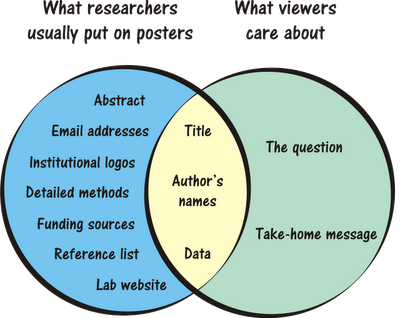
I particularly liked the link Bone Girl posted to Better Posters, a whole blog targeted to the academic crowd (by an academic). The blog contains very good general points (no more than 2 fonts, don't use comic-sans, etc.) and lots of nitty gritty (columns, color theory, poster critiques, fonts and more fonts, poster software reviews, etc.). I particularly liked this graphic, from the Poster Venn post:

I disagree that no-one cares about references, though; or contact info. But the rest? Yeah, I see his point (though some funders require you to mention them whenever you present info they paid for).

Another website on creating good posters that leads by example: An Effective Poster
This site is much more of a how-to, from start to finish, than Better Posters. If you need to make a poster fast, I recommend Effective Poster because it will sequentially walk you through the steps. If you have some additional time, or want to improve a poster you've done, or are just interested in the process and considerations, then definitely pop over to Better Posters.

Friday, February 11, 2011

Archaeology in New York City

The New York City Landmarks Preservation Commission has made their library of archaeology reports accessible online. The reports (almost 1,200), available online as .pdfs, are searchable by keyword and borough. It looks like the keyword search hits author, title, and abstract.

It is exciting to have ready access to this otherwise grey literature (research that is done, but not published) -- not just regarding specific archaeological projects in NYC, but also to the incredible and detailed micro-histories of parts of the city that are included in the historic contexts sections. I've done some work in NYC, and the histories of individual properties can be fascinating.

For a really fascinating take on changes in the NYC landscape when the street grid was dropped on it in the early nineteenth century, have a look at geographer Reuben Rose-Redwood's 2002 MA thesis, Rationalizing the Landscape: Superimposing the Grid upon the Island of Manhattan. Manhattan used to be rolling hills; they flattened it for the grid, and didn't pay *any* attention to former property lines or buildings. Amazing.

For some really great archaeological work in NYC, check out the series of reports titled Tales of Five Points: Working Class Life in Nineteenth Century New York. Six volumes of really great stuff, now available for free online thanks to the NYC Landmarks Commission:

Volume 1: A Narrative History and Archeology of Block 160, by Rebecca Yamin (2000).
Volume 2: An Interpretive Approach to Understanding Working-Class Life, by Rebecca Yamin et al. (2002)
Volume 3: Documentary Data, by Rebecca Yamin et al. (2002)
Volume 4 (2 parts): Basic Artifact Inventory Part I, and Part II, by Rebecca Yamin et al. (2002)
Volume 5: Conservation of Materials, by Rebecca Yamin et al. (2000)
Volume 6: The Long and Short, Being a Compendium of 18th and 19th C. Clay Tobacco Pipes from the 5 Points Site, by Rebecca Yamin et al. (2002).

Saturday, November 6, 2010

Public Archaeology

1. I'm still alive, and life is pretty good, especially when I stop freaking out about looming grad school application deadlines, and just work on getting the suckers finished up and out the door.

2. I've been doing some reading in applied anthropology/applied archaeology/critical archaeology/engaged archaeology and all those other variations that involve archaeology being explicitly relevant, engaged, political, and collaborative. I found this summary of what public archaeology is, and wanted to share, since it's generally one of those amorphous concepts:

[Public archaeology is] more than learning how to handle volunteers at the site, making public talks, and presenting archaeological information in interesting ways. It includes those aspects, but also includes a willingness to share fully in both the production and presentation of archaeological knowledge, and to engage in the debates that surround public perceptions of those materials. (Carol McDavid, quoted in Michael Lucas)

Sources:
McDavid, Carol (1997) Introduction: In the Realm of Politics: Prospects for Public Participation in African-American Archaeology. Historical Archaeology 31(3):1-4

Lucas, Michael T. (2004) Applied Archaeology and the Construction of Place at Mount Calvert, Prince George's County, Maryland. IN Paul A. Shackel and Erve J. Chambers Places in Mind: Public Archaeology as Applied Anthropology, Routledge, New York, pp. 119-134

Tuesday, October 19, 2010

Two Too Cool Sites

There are two, and they are too cool...

1. Abandoned America. Fantastic photography of abandoned sites including hospitals, asylums, steel works, commercial, military, etc. Gorgeous photos; the ones of Bethlehem Steel took my breath away. Alas, I don't remember where I came across this link.

2. Insignificant Topographies. Zoom in super close for the history (?) of things you see (and ignore) every day. Link gleaned from the Contemporary Archaeology email list (check it out if you're into the archaeology of the recent past, or happen to be a theory wonk). This big-to-small zoomy thing is a bit clunky, but has a ton of possibilities for presenting sites to the public.

Friday, October 15, 2010

And Breathe...

Clear Water, October 15, 2010


October is whooshing by; hell, the whole year is whooshing by! I've been super busy. Visited Prospective Grad School South Of The Mason-Dixon Line, which went very, very well; got a collaborative paper mostly written (this weekend's job); FINALLY heard back from someone regarding photo permissions for The Book (I've been trying for almost 2 years now); and got to visit OMGSuperCoolSite again. Which is looking increasingly promising, and I'm so excited I could bust.

I will sleep in November sometime. In the mean time, here are some photos from my October Adventures:

Grant's Tomb (The General Grant National Memorial), Riverside Park, New York City, October 2, 2010. According to the National Park Service (of which this is part), it is the largest mausoleum in North America. How could I not go see that? Unfortunately, I could not get inside, as they were closed.


Part of "The Rolling Bench" by Pedro Silva and the Children of New York City, October 2, 2010. This sculpture, done in 1972 to commemorate the 100th birthday of Yellowstone National Park, snakes around the entire perimeter of Grant's Tomb. A very cool public art project; I had to walk around the whole thing and check it out. An odd juxtaposition with Grant's Tomb, though.


Near OMGSuperCoolSite, October 15, 2010.

Saturday, October 2, 2010

Out of Towner and Some More Alternate Public History

Home from New York City. On the Subway, after chatting with the woman beside me a little about what trains were running where and when (track maintenance, whee!) ... she says "You don't strike me that you're from the City. Where are you from?" Too funny; 2 minutes of conversation, and she knows I'm not from NYC! Before I could ask her why she said that, our train had pulled into the stop, and she was gone.


Back in February (holy shit, the year has vanished...), I posted a link to Kymerica, a faux public history about a place that doesn't exist... except now it does, because it has sites and site markers and history. There is another, similar project called the I-75 project, that I found out about here, via a post from a Facebook friend (who says FB is useless?). The I-75 project, instigated and carried out by Norm Magnusson, places faux historical markers at rest stops along Interstate 75. The gist is a little different from the Kymerica project, in which an alternative universe is created through memorialization. The I-75 project challenges viewers by memorializing social and political ideas and commentary. I think it's pretty compelling, and I'd love to hang out by one of his installations for a while and see what people's reactions are. Brings up questions about memory, legitimacy, and significance. Does just sticking a historical marker at a place make it significant? Can you create history? If someone reads one of the signs, gets inspired, and then goes out and changes the world, does that then make that place truly significant? Apparently, several people who see the signs are unsure whether they are "official" or not, which makes me think that we have a LOT of public education to do.

Wednesday, August 25, 2010

Bated Breath, Pins and Needles, Fingers Crossed

No no, not waiting for grad school application responses YET, though there was some progress in the transcript department.... after giving me a new, 7-digit student number, which also didn't work in the online payment system, they finally realized I've been out of school so long that my shit isn't digitized. So, they will let me use the old-fashioned telephone to pay for my transcripts.

Anyway.... the pins and needles, etc.

I've been having several discussions with people regarding grad schools. Where is good, thoughts on statements of interest, picking advisors, that sort of thing. In one conversation with a colleague, zie mentioned that it is good to go in with a site, rather than taking what they give you, or doing a non-site degree (i.e., analyzing stuff that others have dug up years ago, and which is now mouldering in storage).* The reason zie gave is one I didn't actually consider: once done with PhD work, and on the job market, hiring schools generally want their archaeologists to hit the ground running with a field school. You cannot hit the ground running without a site; so, in a case of all-else-equal, an applicant who can guarantee a field school in Summer 1 will get the job over an applicant who could probably pull something together for Summer 1. Makes total sense, and I filed this tidbit under "things to fret quietly about."

I have ideas of things I want to study; broad brushstroke-y things In A Particular Theme. Within that Theme, there are various Big Questions that I find interesting**. And then there is a particular research question staring me right in the eye (it's all very cross-disciplinary too, which is exciting, though I'm not sure how the Historians will feel about it; hey, I'd let you present at my conference...). But, I do not have a site.

Then. Yesterday. I receive an email out of the blue (yes, handing out your business card to anyone who will stand still long enough to take it, pays off). What would be involved in doing an archaeological dig at OMGSuperCool site?

So, I explained what's involved... lots of little holes, a few bigger holes, lots of bigger holes, possibly heavy equipment, you know, depending. And I explained that hiring someone to do it can be costly (though there are grants available, especially for OMGSuperCool site).

Or, I explained, someone could do excavations as research for their PhD. And then I mentioned that I am applying for my PhD. And that I would LOVE to dig up OMGSuperCool site, because it is OMGSUPERCOOL *and* fits perfectly with my Particular Theme and Big Questions. Not so much with the beady-eyed research question I have in mind, which continues to stare me down, but I can bat that sucker around elsewhere. So, I explained, the PhD route is cheaper, invariably will involve public archaeology/field school, is grant-fundable, but will also take longer than hiring someone. And then I said that if they're interested in pursuing this to let me know, that I'd love to discuss it further.***

And now I am waiting. Impatiently. And hopefully. Did I mention it would be SUPERCOOL?


Tangent Storage For The Very Tangential:
* Artifacts mouldering in storage totally need to get analysed and written up. There is no point excavating stuff if you're not going to do anything with it. But colleague makes a good point.

** Big Questions in Historical Archaeology include: why do people buy what they do? How do we (or is it even possible to) identify ethnicity in the archaeological record? What about gender? Class? What happens when two groups of people meet? How does the individual interact with society and what does that look like in what they leave behind? What can I tell about these people, who I cannot find in the documentary record? What does their voice tell us about the world?

*** I would be STOKED if I could mention the possibility of digging at OMGSuperCool site on my grad school applications. Which I can't do, unless OMGSuperCool site people express an interest.


Sunday, June 20, 2010

The Deepwater Horizon Disaster and Cultural Resources

The Deepwater Horizon Oil Disaster continues to unfold. While there is some good news that they've been able to capture some of the oil currently spewing out of the ground, they're not catching all of it. Frankly, based on BP's track record of blowing smoke on how much oil is gushing into the oceans, I don't believe their numbers. I will go with "they are catching some of it."

Part of the problem with BP bullshitting about how much oil there was flowing into the ocean, is that the emergency response was planned around those really, really low numbers (1,000 barrels a day, they said). Most people are aware of the ecological impacts of the oil to the fisheries, marshes, and wildlife, and of the economic impacts to the fishermen, tourism industries, and even the oil industry. But most people are not aware that the spill also has impacted, and will continue to impact, cultural resources, including historic and prehistoric archaeological sites, historic structures, Civil War military sites, shipwrecks, etc.

For starters, here is the oil spill as it was on June 5, with Binghamton, NY as its source (still nothing personal, B'ton...):

The spill projected with Binghamton, NY as its source, as of June 5, 2010. Via Ifitwasmyhome.com


Here is the projection as of June 18, 2010:

The spill projected with Binghamton, NY as its source, as of June 18, 2010. Via Ifitwasmyhome.com

US/ICOMOS (U.S. National Committee of the International Council on Monuments and Sites) has a website with an interactive map where you can see cultural resources that are threatened by the spill, and areas where the spill has reached the shore. It doesn't translate as anything I can reproduce here, but click on the link above, and then click on the icons for details on the cultural resource. It looks like a lot, but they've left off archaeological sites and shipwrecks to discourage looting. The potential for archaeological sites along the waters' edge, particularly around marshes and tidal estuaries is generally pretty high -- transitional zones like that often provide a huge variety of food resources, as well as access to the Gulf for travel and trade, and easily accessible areas for initial exploration and settlement. The number of shipwrecks noted for the area is "many." I was alerted to this link from the Historic Preservation Group at LinkedIn.

The National Park Service also has a website detailing their response to the Spill. Several National Parks and properties listed on the National Register of Historic Places (which is managed by the National Park Service) are being affected.

And finally, we shouldn't forget that eleven people lost their lives when the rig exploded in the first place. This huge disaster and its media circus is also a very, very personal tragedy for people who have lost friends and loved ones, and for those whose means of making a living have also been lost.

Monday, May 31, 2010

Sleep Away May : Pix!

Interior arch, Wiawaka, May 31, 2010


May has been busy, what with the online course, garage sales, regular work, etc. etc. But I've also managed to sneak away a couple of weekends.

Dance camp morning, May 1, 2010

At the beginning of the month, I went to a dance camp. It's a sleep away, where, for the entire weekend, you eat, sleep, and dance. I had a total blast. Only one picture from there; I was too busy dancing (or sleeping) for much more. The water was just cold enough that it felt good on my feet, but too cold to jump in.


Lake George shoreline, May 31, 2010


And, I've just returned home from a women's retreat up at Lake George, New York where I helped with their season-opening preparations. There were almost 40 of us there pitching in; a great time, and a stunning property. Georgia O'Keefe stayed there when she was a student. Opened in 1903, Wiawaka is the only remaining operational women's retreat center begun during the early twentieth-century women's rights movement. If you need to recharge your batteries, this is the place.


Upstairs Bathroom, Wiawaka, May 31, 2010


Labyrinth, Wiawaka, May 31, 2010


Remains of a springhouse, Wiawaka, May 31, 2010


Treefall, Wiawaka, May 31, 2010

Sunday, April 18, 2010

Public History: The Constitution

The Assembly Room at Independence Hall (a.k.a. the Pennsylvania State House), from the NPS Independence website.

My family visited this past weekend; it was great to see them, even though it was a total whirlwind (much of my life these days is a total whirlwind...). On Saturday, we hightailed it to Philadelphia. Admission to Independence Hall is by ticket (you might be able to squeeze in without one, but it's a long shot). Tickets are free, but don't wait... on this cold April day, we got 4 of the last 9 tickets at noon. I've not spent much time in Philly, most of it work related, so I haven't seen the sights. Particularly as a Freshly Minted American Citizen, I wanted to see Independence Hall, so was pretty jazzed to get some of the last tickets of the day. It's a super-fast, half hour tour, which I guess makes sense, given the numbers of people they must wrangle through there a day.

What struck me during the tour was the part in the Assembly Room, where our guide, a big tall fellow with a BOOMING voice, explained that, when written, the Constitution only expressed the rights and responsibilities of citizens: 21-year old white males who owned property. But that the framers included the ability for the Constitution to change,and as the times and the country have changed, the rights granted by the Constitution have been extended to other groups, including African Americans and women.

I found this official, National Park Service description of the Constitution and it's original limitations and later expansions, refreshing. It was especially poignant in conjunction with the Tea Party Protest going on just next door.

The Tea Partiers had tables and a band, and know how to work their symbolism (a protest, at Independence National Park? Very symbolic!). They were also having people approach you to sign petitions, and were giving out flags. It was more like a festival than a protest; and for the TV cameras? All the people who are just hanging out listening to the music look like they're protesting. Other factions (hello, Democrats!) could take a few lessons in media manipulation.

Philly Notes:
  • The trolly/Big Bus tour was totally worth the time and $$. We got an overview of LOTS of the city over the 90 minute tour, with narrative, and you can use your ticket all day for transportation. Our driver also went out of his way to arrange van transportation for us, for free, to get us to dinner.
  • Your jackets and bags will be searched going into Independence Hall. You CAN, however, take pictures inside.
  • The Park Service public bathrooms across from Independence Hall are very convenient, and were even relatively, mostly clean at the end of the day. They were -actually- clean before lunch.
  • Plan to spend more than 1 day, even in Independence National Park.
  • They had a hammered dulcimer player in the Visitors' Center! I love hammered dulcimer.
  • The ghost building they are constructing between the Liberty Bell building and the Visitors' Center, on top of the Presidents' House, is going to be very cool.
  • I will have to spend more time bumming around Philly; I really like it!

Saturday, March 20, 2010

The Persistence of Memory

The Persistence of Memory, by Salvador Dali. Original at the Museum of Modern Art, NYC

I was just up in the Finger Lakes region again; I seem to be on some sort of quarterly schedule to get up that way. While up there this time, I stopped in Seneca Falls at the Women's Rights National Historical Park, part of the National Park Service (NPS). Work on the rehabilitation of the Wesleyan Chapel, where the first U.S. Women's Rights Convention was held in 1848, is finally underway.


Wesleyan Chapel, undergoing reconstruction. March 18, 2010.

What struck me about this site is the persistence of memory. That this location, in a small town in Upstate New York, has been remembered as the location of Something Important, even though the physical place was almost entirely obliterated.

The Wesleyan Chapel was built in 1843. It went up very quickly; those Wesleyan Methodists didn't waste time on anything. They split from the main body of the Methodist Episcopal Church over irreconcilable differences regarding the abolition of slavery, holding their first formal meeting in February of 1843 in Andover, Massachusetts (Brown 1987; Weber 1985). In March of that same year, the First Wesleyan Methodist Society of Seneca Falls was formally organized; in May they bought a vacant lot; by July construction of the church was underway; and on October 14, 1843, the church was dedicated (Brown 1987). The original structure measured 64 feet by 44 feet, and was built of local brick. A second floor balcony ran around three sides of the interior.

As well as a location for regular services, the church was also the location for several lectures and meetings, ranging from philosophy to politics, abolition, and temperance. The church was made available to these speakers free of charge (Brown 1987; Weber 1985). It was not at all a strange choice of location, therefore, for the first U.S. Women's Rights Convention organized by Elizabeth Cady Stanton, Lucretia Mott, Martha Wright, Mary Ann M'Clintock, and Jane Hunt.

Approximately 300 people attended the two-day convention on July 19 and 20, 1848. Sixty-eight women signed the resulting Declaration of Sentiments; 32 men, including Frederick Douglass, signed their names in support of the women. I was doing the math while I was up there; it would be only barely possible to jam 300 people into the building, assuming each person only required nine square feet (3x3); certainly not everyone would have been in simultaneous attendance, but I can imagine people were also congregating outside the church, conversing and debating along the streets and on the adjacent open lawn.

In 1872, the Wesleyans of Seneca Falls moved to a new church. Their old, 1843 church was sold, and renovated to serve as an entertainment venue, as well as having storefronts along Fall Street. Subsequent owners renovated the building for use as an Opera House, a movie theatre, automobile showroom and repair garage (complete with a ramp to drive vehicles up to the second floor), fire hall, apartment building, and (ironically) a laundromat (Brown 1987). The structure of the Chapel had been virtually obliterated; no one looking at the building, even in the late nineteenth century, would see a church.


The Wesleyan Chapel from 1962-1985. It's in there, really! Image from the Women's Rights NHP website.

In 1932, a commemorative sign was placed by the New York State Education Department at the corner of Fall and Mynderse Streets, reading "First Convention for Woman's Rights Was Held On This Corner in 1848" (you can just make it out in the photo, above). Though this could be read that women met on the corner, as though it was a street protest, it underscores how GONE the chapel was. The sign doesn't commemorate their meeting in the building at the corner (in 1932, it was a car dealership and garage), but at the corner. Despite the disappearance of the chapel, women continued to remember this as the location of the Convention, and continued to meet at the corner, often trying to meet within the building. Some owners let them in; others, including one of the dealership owners, refused.

In 1985, the National Park Service purchased the property (then an apartment complex and laudromat). A national design competition was run to determine how to develop the new park. The winning design included the removal of all building and structural elements not associated with the 1843 church, with a few elements added to keep it standing. The result was essentially a standing ruin.
The Wesleyan Chapel in 2007. Image from the Women's Rights NHP website.
The lighter brick and steel roof are modern materials to keep the structure standing. The darker bricks are original to the 1843 chapel; portions of the original roof and wall plaster are on the interior. Original portions of the foundation survive below grade.


In order to address conservation issues associated with making the former interior of the Wesleyan Chapel exposed to the exterior elements, with vandalism, and with confusion on the part of visitors regarding what they were looking at, the NPS is rehabilitating the Chapel. Using what is known, the Wesleyan Chapel is being reconstructed, incorporating surviving elements, on its original foundations (Orcutt et al 2007).


An artist's rendering of the completed reconstruction of the Wesleyan Chapel. The red brick is original to the 1843 structure; you will be able to tell on sight which are original and which are reconstructed elements. Image from the Women's Rights NHP Website.


The result will be much more legible as the Wesleyan Chapel. But I wonder about this reconstruction. The persistence of the memory of the convention makes it clear that it is not the building that is important, but the place. And I am generally troubled by the sterility of historic reconstructions and many living history museums; they feel like just-so stories. What I hope is that the NPS utilizes the space within the new Chapel building for meetings, conferences, lectures, and other programs associated with women's history, women's rights, and women's experiences. It would be totally consistent with the Wesleyan's use of the building, and would do ongoing honor to those 100 who spoke up in 1848.


Sources:

Brown, Sharon A. (1987) Historic Structure Report, Historical Data Section, Wesleyan Chapel, Women's Rights National Historical Park, New York. NPS.

Orcutt, Tina, Jennifer McConaghie, Cheryl Sams O'Neill, Christopher Tavner, and Mark Warner (2007) Women's Rights National Historical Park - Wesleyan Chapel, Seneca Falls, New York: Rehabilitation and Preservation of the Wesleyan Chapel Environmental Assessment / Assessment of Effect. NPS.

Weber, Sandra S. (1985) Special History Study, Women's Rights National Historical Park, Seneca Falls, New York. NPS.

Tuesday, February 23, 2010

Still alive...

Holy crap, it's been 18 days since I last posted. Needless to say, much is going on. The cold is gone, the deadline is now past (it made a lovely whooshing sound on its way by) and the project is now overdue. At least it's overdue on an internal deadline, and not a to-the-client deadline, though that is starting to become an issue. Some very, very cool stuff in this report, though. It has been very challenging to work through and to write, but very rewarding. There are bits and bobs to mull over here; I'll get to it.

In the rest of life... well, 'tis a roller-coaster. One minute I'm feeling very tall and together (h/t Clio); the next, the rug is gone and I'm free-falling. In an unpleasant sort of way. Much change is afoot; I may post more about it in the future. This is one of those "you can't go over, under, or around it, you must go THROUGH it" situations, and it does feel a lot like a brick wall sometimes. To those who've listened to me kvetch, or asked how I've been... truly, you've been more support than I can properly describe.

While I continue to pull myself together (or hold myself together, depending on the moment), here are some links:

Tired of Tea Party shenannigans in the media 24/7? Bully Bloggers presents The Cocktail Party, "a barstool-roots movement for left wing urban homosexuals and the people who love us." Sign me up! When do I get my membership card and copy of the agenda?

The University of Pennsylvania museum has an "Anthropologists in the Making" summer camp. How cool is that? They're hiring counselors.

The Promise is a multi-media presentation of the Civil Rights movement from the New Yorker. I was captivated.

Old is the New New posts a blog entry about Kymaerica, an alternate public history project that makes Places out of no-wheres, and Significant Events out of thin air. If you think historical markers are a little silly and irrelevant (or even if you think they're an important part of Public History and Public Memory), have a look.

And finally, a Food and Drink in Archaeology Conference. In April. In England. Add it to my list of conferences I'd love to attend, but won't be! Hopefully they post papers on the 'net, or publish a proceedings.


PS: I applied for the jobs. To quote the fine folks at the lottery, "if you don't play, you can't win." I'll worry about taking/not taking said jobs if they ask me if I want them :)

Sunday, January 31, 2010

Crowdsourcing Public History

Check this out... it's an historic pub crawl, where the locations of the historic pubs (tavern sites 100 years old or more) are provided by site visitors. There is an interactive map, and locations of taverns still serving, still standing, and gone forever are all welcome. A very cool idea! The same folks are also mapping one-room schoolhouses using the same system.

The link above goes to the historic pub crawl website; the image below is of the map. I don't like all the crud overlying the map itself, but once you get past it, pretty cool!


Saturday, January 30, 2010

Weekend Randomness

Field of Brussel Sprouts and Apple Orchard, January 28, 2010


A post of randomness, with a photo. Alas, apparently there was no market for brussel sprouts this year.


  • There are two job openings I'm *very* interested in. Except they'd interfere with PhD aspirations. I am considering applying anyway to see where the cards fall. Where is the line between keeping options open and burning bridges? They're both at an institution I would love to work for.
  • A CFP for an interdisciplinary symposium entitled "The Body On Display from Renaissance to Enlightenment" sponsored by the Society for the Social History of Medicine. Symposium is in July of 2010. A little late to get an abstract in, but the symposium looks very, very interesting.
  • Did you know the dictionary contains "words of concern?" A school district in South Carolina has pulled dictionaries from the classrooms while they decide whether to ban it. Yep, you read rightly... ban the dictionary. For containing words. [h/t Banned Books]
  • Flavia makes a post about teachers being public intellectuals. I think the premise is an important one -- that our students are not just students, but are also The Public. I really appreciated the discussion of approrpiate/inappropriate invocations of the present in the classroom. I agree that what is appropriate is likely field-specific. There is a lot of politics in the world of physical anthropology, and I try to address those in context. In my other life, clients in the world of CRM are also members of The Public. Yes, the work we do for them is so they can get their construction permits, but occasionally you get clients who (although they don't want to pay for it) are actually interested in the sites and the process. I do wish that CRM reports were not so "gray" when it comes to public access, however. Reports are all filed with the State Historic Preservation Office (SHPO), and are therefore "public," but certainly not public in the sense of Public Archaeology or Public History. And neither my employer nor our clients (unless mandated by the SHPO) are paying me to get results out there either through publication or presentations.
  • Copper is being stolen from historic sites. This isn't just limited to the copper piping in unattended buildings; thieves are now stealing historic site markers and other copper signs from sites. Keep your eyes peeled; if you notice a sign that has always been there is suddenly gone, don't assume it's off being repaired. Contact whoever is in charge of marking historic sites in your region, and let them know it's gone. In the US, your local SHPO/Tribal HPO can help you find out who to contact; a list can be found here.
  • Some very cool digital restoration of the Lienzo de Quauhquechollan, integrated with GIS mapping. A very, very cool application for GIS and education. A lienzo maps both the geography and the history of a place in one document, aka historical cartography. The previous link is to an article about the process; the link to the project website is here.

Thursday, January 28, 2010

A Scientific Breakthrough in Feelings

"Every Lady Scientist Who Ever Did Anything (until recently)" By Kate Beaton


I love Kate Beaton. Smart, funny, and talented, she goes right to the heart of the funny in history. Even when it isn't really funny. (Yes, I'm one of those people who laughs at what apparently everyone else thinks are inappropriate moments.)

Rosalind Franklin produced much of the data used by Watson and Crick in identifying the double-helix formation of DNA, and apparently had actually beaten them to the punch. Watson and Crick got the Nobel. Rosalind got disappeared until the late 1960s, when Watson published his memoir acknowledging her major contributions. Rosalind died young; she was only 37 when she passed away.

Unfortunately, crap like this is not limited to the pure sciences. Nor is the practice dead, I'm afraid (though things are definitely better than they were).

Friday, January 22, 2010

A little bit of history can be a bad thing.

I have a search set up on my Twitter account for "Seneca Falls." Usually, the results are various jobs available, the local radio station plugging itself, folks tweeting about listening to The Distillers sing their song about the first Women's Rights Convention held there in 1848, the odd news story.

This evening though... a completely different story. Several tweets floated by with some variation of "Finally, the Seneca Falls for Men’s Rights!" I knew I'd get bent, but I clicked the link anyway. I really don't want to link to the dreck that's out there on this, but if you google "Finally the Seneca Falls for Men's Rights" and MWD (that's Men's World Daily), you'll hit it. Apparently this watershed moment is the inception of a Men's Studies course at Wagner College, Staten Island New York. The drivel is the same old crap about how teh menz have been deeply wounded by the existence of Women's Studies courses, how men weren't allowed to take them, how the world is out to get them, etc. etc. The irony of this following so closely on Mary Daly's death is not lost on me.

The same old crap bugs me; a lot. But what really gets my goat is likening a Men's Studies course at some college to the Seneca Falls convention. This level of understanding of the Seneca Falls convention must come in somewhere around "some thing feminists think is important" to be likened to a university course. Because, you know, fighting to be acknowledged as actual persons, with the right to vote... that's TOTALLY the same thing as someone offering a class about people who have always been people.

I'm not entirely sure I have been coherent. This post brought to you by ARRRGH.

Tuesday, October 27, 2009

Ah, Those Wacky Resurrection Men!

Trained in History, Kate Beaton creates comics based on historical events and people. Sometimes, she takes liberties. Sometimes, she doesn't have to. Always hilarious. I love her stuff; she's in my blogroll over there as Hark, A Vagrant! As much as I'm dying to post images of her fantastic "History is Serious" shirt, and to her Ben Franklin flying a kite shirt, I will content myself with links. Because this post is about Resurrection Men.

I posted earlier about resurrection men acquiring recently-dead bodies for use in anatomy classes. When freshly-dead bodies were not forthcoming, some resurrectionists resorted to a DIY approach, and became murderers. Kate Beaton posted a comic recently recounting the exploits of Burke and Hare, infamous providers of cadavers who weren't quite dead when Burke and Hare first met them. In her post, Kate links to the following, which was entirely too good not to share:


Edited to make the YouTube thingy not quite so enormous.